
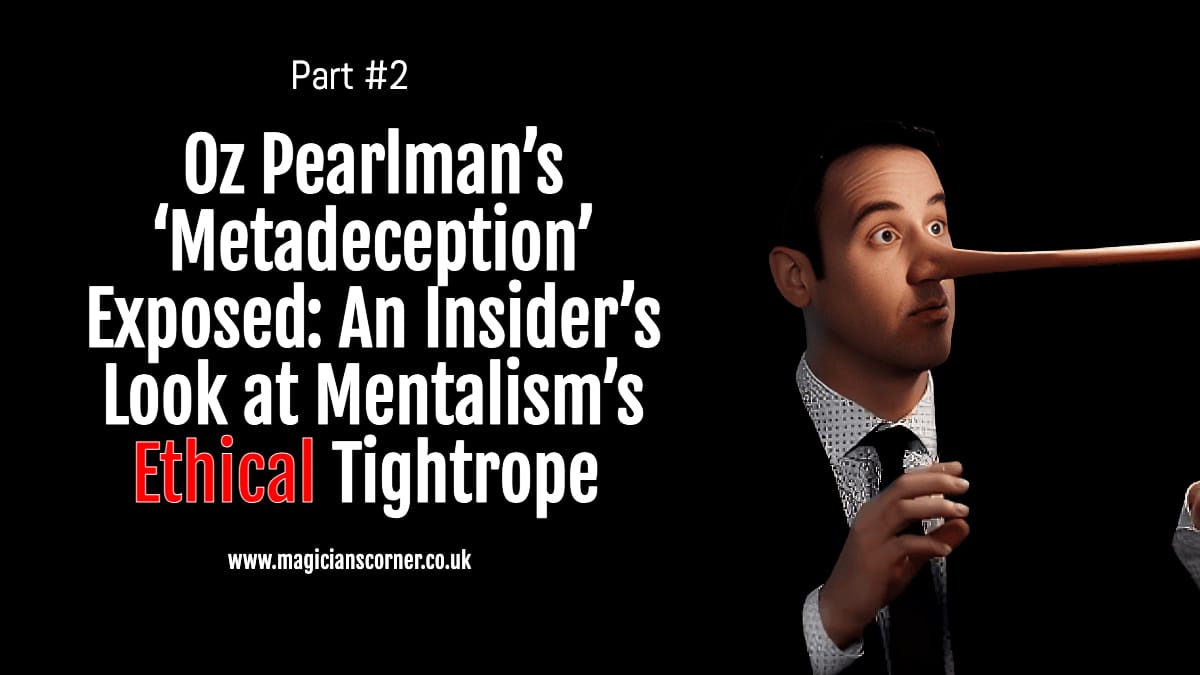
Metadeception Unmasked: A Magician's Deep Dive into Oz Pearlman's Viral Performance
The Why!!.
As a magician who has dedicated a lifetime to the art of deception, watching the YouTube video 'Metadeception: The Truth About Oz Pearlman' was a familiar yet uniquely compelling experience.
Oz Pearlman's "Metadeception": The Performance Under Scrutiny
This is the viral Oz Pearlman performance from 'Metadeception' that has sparked widespread discussion and expert analysis within the magic community.
It’s not every day that a performance generates this level of buzz, prompting both awe from the public and intense debate within the magic community.
Oz Pearlman's performance in 'Metadeception' is a masterclass in modern mentalism, blending exceptional showmanship and psychological manipulation with performance aspects that are ethically ambiguous and potentially reliant on the context of the video medium itself. This creates a powerful, albeit controversial, piece of magical theater that merits a closer look.
This post will serve as a professional critique, moving beyond simple awe to dissect the layers of Pearlman's work.
We will explore not just what he does, but how he does it and, more importantly, what it means for the art of magic.
Key Points:
- Masterful Showmanship: Pearlman exhibits an elite-level command of audience management, pacing, and character, which are the foundational pillars of any world-class magic performance.
- Psychological Nuance: The performance is a textbook example of applied psychology, using suggestion, misdirection of the mind, and rapport to create the illusion of genuine mind-reading.
- Ethical Gray Areas: The analysis will address the "problematic" elements, including the potential use of methods that blur the line between clever deception and misleading the audience about the conditions of the performance.
- The "Meta" Deception: A critical part of this breakdown involves questioning the role of the video itself. We will examine whether the final product is an accurate representation of a live event or a performance constructed in the editing room for a digital audience.
Setting the stage for a comprehensive deconstruction of Oz Pearlman’s viral video. By the end of this analysis, you will have a deeper appreciation for the intricate skills involved and a more informed perspective on the complex ethical questions that modern mentalism presents. We will break down the tricks, evaluate the performance choices, and offer a conclusive takeaway on the true nature of this "metadeception."
Unveiling the Method: Dissection of Pearlman’s Techniques
To the untrained eye, Oz Pearlman’s performance in 'Metadeception' appears to be a genuine display of psychic ability.
However, for a seasoned magician, it is a beautifully orchestrated symphony of established mentalism principles, psychological manipulation, and flawless execution.
Here, we peel back the curtain to analyze the core mechanics that make his illusions so profoundly convincing.
The Foundation: Psychological Forcing and Priming
Much of Pearlman’s success is established long before the "trick" officially begins.
He is a master of psychological forcing, a technique designed to subtly guide a participant toward a predetermined choice while maintaining the illusion of a free selection.
- Verbal Subtlety: Notice his use of language. Phrases like "Think of a simple shape, nothing too complex like a dodecahedron... just something simple you can draw easily, like a star or a house," may seem innocent. In reality, this is a classic "restrictive choice" method, limiting the spectator's mental options and dramatically increasing the odds of them selecting one of the suggested items this is just an example Oz uses much more advance tactics and even says so in his perfromances his not a mind reader.
- Non-Verbal Cues: Pearlman often uses gestures to prime his subjects. In the segment where he divines a chosen number, watch how he subtly taps his fingers or holds up a certain number of digits while talking. This subconscious suggestion, known as priming, plants a seed in the spectator's mind, making them more likely to "randomly" select the number he wants.
These foundational techniques are not mind-reading; they are mind leading. Pearlman constructs a psychological maze where every path leads to his desired outcome.
The Centerpiece Effect: A Deconstruction of the "Thought Reveal"
The climax of 'Metadeception' involves Pearlman seemingly plucking a complex, personal memory from a participant's mind.
While breathtaking, this effect is likely a multi-layered construction combining several methods.
| Method Component | Expert Analysis |
|---|---|
| Billet Work | The most probable core method involves a "billet," a small piece of paper on which the spectator writes their memory. Through sophisticated sleight of hand—a "billet switch" or a "center tear"—Pearlman gains secret access to this information. |
| Dual Reality | Pearlman presents the effect differently to the participant versus the viewing audience. The participant believes their written thought was destroyed, while the camera (and by extension, the YouTube audience) may be privy to a different reality, potentially one where the information is read off-camera. |
| Progressive Anagrams | When revealing the memory, he doesn't state it outright. He fishes for letters and concepts ("I'm seeing the letter 'B'... was this on a beach?") This technique, a form of progressive anagram, allows him to adjust his revelation based on the spectator's reactions, making it seem like he is slowly tuning into their thoughts. |
The true genius is not in a single method but in the seamless layering of these techniques. This creates multiple "outs" and a powerful illusion of impossibility.
The Art of Information Gathering: Cold Reading vs. Covert Intel
A significant portion of Pearlman's act relies on revealing personal details. This is achieved through a masterful application of "cold reading"—a set of techniques used to create the impression of knowing much about a person.
He observes clothing, speech patterns, and body language to make high-probability guesses.
However, the "meta" aspect of the video's title invites skepticism. The precision of some of his revelations raises the question of whether "hot reading" (using pre-obtained information) is at play.
In the context of a produced video, it is entirely possible that participants were researched beforehand, a ethically gray practice that transforms the performance from a clever illusion into a scripted deception.
This is the "problematic" element that divides many in the magic community.
Physicality and Presentation Style
Finally, Pearlman’s physical presence and presentation are tools of deception in themselves.
His intense eye contact builds rapport and creates psychological pressure, making participants more compliant.
His use of a simple notepad and pen feels organic and disarming, lowering the audience's suspicion.
His entire demeanor is a form of large-scale misdirection. By presenting himself as an intense, focused mentalist, he directs attention toward the psychological drama of the moment and away from the mechanical, physical actions where the real secret lies. He sells the effect so powerfully that the audience never thinks to question the method.
The Ethical Framework: Artistic Integrity vs. Market Impact
At the heart of every magic performance lies an unspoken contract, a delicate agreement between the artist and the audience.
The audience willingly suspends its disbelief, agreeing to be deceived for the purpose of entertainment, while the magician promises that the deception is a temporary, harmless illusion.
Oz Pearlman’s performance in 'Metadeception' pushes the boundaries of this contract, forcing a critical examination of where artistic license ends and ethical responsibility begins.
The Perils of 'Over-Proving'
A key technique used to amplify an effect’s impossibility is "over-proving," where the performer goes to great lengths to convince the audience that the conditions are fair and uncontrolled.
Pearlman masterfully employs this by repeatedly emphasizing the fairness of a choice or the isolation of information. He might say, "I won't touch it," or "You're just thinking of it, right?"
While this is a standard and effective theatrical device, it treads a fine ethical line. When over-proving shifts from a dramatic convention to a potential misrepresentation of fact, it risks violating the audience's trust.
For instance, if a spectator is secretly influenced to choose a specific item, the claim that it was a "completely free choice" is, in itself, a deception layered on top of the primary trick. This creates a powerful effect but also raises questions about the honesty of the performance framework.
Dual Reality: Deception for Whom?
The concept of "dual reality" is central to understanding the ethical complexities of 'Metadeception'.
This principle involves creating two distinct experiences: one for the live participant and another for the wider viewing audience. The person in the room might believe their written thought was destroyed and never seen, while the camera edit allows Pearlman to gain the information off-screen.
This technique presents a fascinating ethical dilemma in the age of digital content:
- For the Participant: Their experience is a pure, baffling mystery.
- For the YouTube Audience: They are witnessing a different, perhaps more constructed, version of the event.
The ethical question becomes: who is the performance for? If the method relies on edits and camera cuts unavailable to the live spectator, it challenges the authenticity of the documented event. The performance becomes less about deceiving a person in a room and more about producing a convincing video product, blurring the line between a live magic trick and a short film.
The Weight of Representation and Responsibility
As a mentalist, Pearlman walks a tightrope. He never explicitly claims to be psychic, yet his entire persona is crafted to imply powers beyond the ordinary.
This is the classic mentalist's paradox. The responsibility lies in ensuring the audience understands, at some level, that they are witnessing masterful skill, psychology, and illusion—not supernatural phenomena.
The immense reach of a viral video amplifies this responsibility. When millions view a performance that is presented as a raw, real-time event, it shapes public perception.
The market impact of a viral hit can sometimes overshadow the artistic integrity that underpins the craft. The pressure to create sensational, shareable content can lead to choices that prioritize effect over ethical clarity, potentially misleading a mass audience that lacks the context to differentiate between a clever trick and a genuine miracle. This is the core tension in Pearlman's work: the pursuit of maximum impact versus adherence to the unspoken rules of the magical arts.
Pros and Cons: Balancing Power and Purity
Oz Pearlman’s performance style is a high-stakes balancing act, deliberately trading methodical purity for raw, unforgettable impact.
This direct, high-octane approach is engineered for maximum astonishment and shareability, particularly in a digital landscape.
However, this pursuit of power comes with significant artistic and ethical trade-offs, creating a sharp divide between its undeniable benefits and its inherent drawbacks.
The Power of Direct Impact: Pros of Pearlman's Style
The primary advantage of Pearlman’s approach is its sheer, unadulterated effectiveness in captivating an audience.
He eschews the slow, atmospheric build-up favored by some mentalists for a style that is immediate, visceral, and emotionally resonant.
- Unforgettable Audience Experience: Pearlman’s effects are not subtle puzzles to be intellectually admired; they are emotional sledgehammers. By dealing with personal memories and seemingly impossible revelations, he creates moments that participants and viewers are unlikely to forget, generating powerful word-of-mouth.
- Commercial Viability and Virality: This high-impact style is perfectly suited for modern media consumption. The effects are quick, visually clear, and produce strong, authentic reactions—all key ingredients for a viral video. This commercial appeal is a significant pro, granting him a level of public exposure that more esoteric performers rarely achieve.
- Enhanced Authority and Credibility: The confidence and directness of his method create an aura of supreme authority. By being so bold and rarely "fishing" for information in an obvious way, he projects an image of genuine power, which in turn makes the audience more receptive and the illusions more convincing.
The Purity Under Siege: Cons of the High-Impact Method
While powerful, Pearlman's style courts controversy and risks sacrificing the very artistry that defines classical mentalism.
The relentless drive for a perfect, clean "hit" can lead to compromises that purists in the magic community find problematic.
- Increased Reliance on Problematic Methods: To guarantee the high success rate his style demands, a performer may become more reliant on ethically ambiguous techniques. This includes the potential for pre-show work, stooges, or video editing tricks that go beyond the traditional magician's toolkit of sleight of hand and psychological manipulation. The need for a perfect outcome can overshadow the elegance of a "fair" method.
- Risk of Exposure and Devaluation: Direct, bold effects, especially those that seem too good to be true, invite intense scrutiny. This heightened scrutiny increases the risk of public exposure. When an effect is revealed to rely on simple trickery or digital manipulation rather than psychological skill, it can devalue not only the performer but the art form as a whole in the public's eye.
- Alienation of the Magic Community: While the public is enthralled, many expert magicians and mentalism purists are critical of this approach. They argue that it prioritizes the "what" (the effect) over the "how" (the artistic method), potentially misleading the audience about the nature of the skills involved and creating an unsustainable standard of impossibility.
A Comparative Analysis: Power vs. Purity
The tension between these two poles can be clearly illustrated. Pearlman's choices represent a deliberate move toward one end of the spectrum, with clear benefits and consequences.
| Performance Aspect | High-Impact (Power) Approach | Method-Focused (Purity) Approach |
|---|---|---|
| Audience Reaction | Aims for shock, emotional outcry, and visceral astonishment. The reaction is the primary goal. | Aims for intellectual appreciation, a sense of wonder, and a slow-burning mystery. |
| Methodology | Prioritizes any method that guarantees a clean, powerful effect, even if ethically gray (e.g., video edits). | Prioritizes elegant, skillful, and "fair" methods, even if the effect is less bombastic. |
| Risk Profile | High risk of exposure and criticism from experts, but high reward in terms of public acclaim and virality. | Low risk of ethical criticism, but potentially lower commercial appeal and a more niche audience. |
| Artistic Statement | "I can do the impossible, and I will prove it to you in the most direct way imaginable." | "Let us explore the boundaries of perception and mystery together through skillful deception." |
Ultimately, Pearlman’s style is a calculated decision. He chooses the path of maximum impact, understanding that it may come at the cost of methodological purity and the approval of his peers. This approach makes him a titan in the public sphere but a controversial figure within the inner circle of the magic world.
Wisdom for Aspiring Magicians: Conclusions & Key Takeaways
The analysis of 'Metadeception' reveals Oz Pearlman's performance as a multifaceted display of modern mentalism, combining psychological techniques and masterful showmanship with ethically complex elements potentially dependent on video production.
This approach achieves a powerful effect but also invites scrutiny regarding the authenticity of the documented event.
Things To Remember:
- The performance relies on established mentalism principles, including psychological forcing, billet work for information gathering, and cold reading techniques to create the illusion of mind-reading.
- Ethical questions arise from the use of "dual reality," where the video audience may experience a different version of events than the live participant, and "over-proving," which can misrepresent the fairness of the conditions.
- Pearlman's high-impact style is commercially effective and creates a powerful audience experience but risks a dependency on methods considered ethically ambiguous by some in the magic community, such as potential pre-show research or video editing.
- The performance represents a strategic choice, prioritizing direct, powerful impact and commercial virality over the methodological purity favored by some classical mentalists, making him a popular but controversial figure.
This analysis addresses the core techniques, ethical considerations, and performance style choices within Oz Pearlman's 'Metadeception'. Wrtten with the help of AI